In this article
Quick answer
Admission marketing works best when it follows the admissions calendar: build visibility months before the window, capture families who search during it, and make enquiring and applying quick. Track every enquiry through to application and admission, because leads often convert two to three months later and the biggest losses usually happen between enquiry and form.
Colleges, universities and schools compete for the same students in a short window each year. Parents and students compare options over weeks or months, ask friends, read reviews and visit several websites before they apply. Marketing that chases only the last click misses most of that journey. This playbook comes from our work with SRMU Lucknow, DIS School and SRMCEM.
Why admissions marketing is different
- Two decision makers. Students choose the course; parents usually approve the fees and the institution. Your message has to work for both.
- A long, seasonal decision. Interest builds for months, then peaks around results and admission dates.
- Results lag spend. At SRMU, leads generated from April to June mostly became admissions in July and August.
- Trust matters as much as reach. Families look for proof: results, campus life, faculty and what current students say.
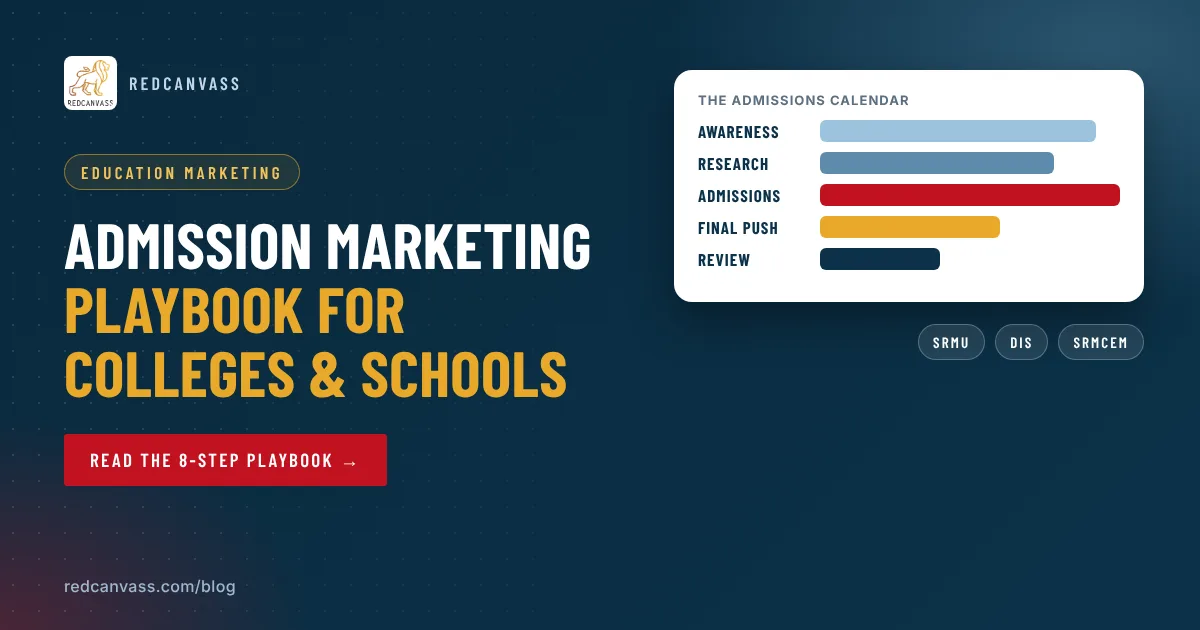
Plan around the admissions calendar
| Phase | What families are doing | Main channels | What to measure |
|---|---|---|---|
| Awareness | Starting to think about options | Meta reach campaigns, YouTube, Instagram content | Reach in target districts, profile visits |
| Research | Comparing institutions and courses | SEO, Google Business Profile, social proof, remarketing | Website visits, course page views, saved audiences |
| Admission window | Enquiring and applying | Google Search by programme, Meta lead forms, call campaigns | Enquiries, cost per enquiry, application forms |
| Final-date push | Last-minute decisions | Remarketing, calls and WhatsApp follow-up, deadline creative | Applications, admissions, follow-up speed |
| Review | Season over | Reports for management | Cost per admission by channel, what to repeat |
Exact months differ by institution. DIS School ran Meta Ads from November to June in its second season, 188 days compared with 90 in the first.
The 8-step playbook
- Fix how families find youClaim and complete your Google Business Profile, collect genuine reviews and check local search. DIS School held map pack positions 1 and 2 for "residential schools in dharwad" and was named first in two tracked Google AI Overviews. See local SEO.
- Put the facts parents need on your websiteFees, courses, eligibility, facilities, hostel details and dates in plain text on your pages. In the DIS audit, fees sat in a Google Drive PDF, where search engines and AI tools struggle to read them.
- Run Google Ads by programme and intentSeparate campaigns for each programme, with negative keywords to cut low-quality clicks and a dedicated landing page for each. This structure helped SRMU grow application forms from Google Ads by 22.4% year over year.
- Keep reach campaigns separate from lead campaignsOn Meta, brand reach and lead generation need different settings and different judging. At SRMU, separating them made it clear which spend bought visibility and which bought enquiries.
- Target by city, not just by stateDIS School ran city-wise campaigns with 35 to 40 km radii across seven North Karnataka districts, tested Bengaluru, then stepped up budget on the strongest cities.
- Offer more than one way to enquireSome parents prefer to call, others to fill a form. DIS ran call campaigns alongside lead forms, and grew lead-form campaigns from about 11% to about 33% of ad sets.
- Fix the step between enquiry and applicationFor SRMU, the enquiry-to-form step was the biggest lever: about 72% of Meta enquiries that reached the application form went on to take admission, so most losses happened before the form. Fast calling, WhatsApp follow-up and a short form matter more than another ad.
- Keep social media steady all yearFamilies check Instagram before they enquire. At SRMCEM, consistent posting and more stories lifted Instagram profile visits 57% from January to September 2026.
Results from these institutions
Results come from our published case studies and depend on the institution, its reputation, fees and location as well as on marketing. They are not a promise of future admissions.
Common admission marketing mistakes
- Starting ads only when the admission window opens, after competitors have built months of visibility.
- Judging campaigns on same-month admissions, which undervalues lead campaigns that convert later.
- Sending every ad to the homepage instead of a page for that course.
- Counting form fills but never checking how many became applications and admissions.
- Slow callbacks during peak weeks, when every hour of delay costs enquiries.
What to report to management
| Number | Why it matters |
|---|---|
| Enquiries by channel and month | Shows where interest comes from and when |
| Cost per enquiry by channel | Shows what each source costs |
| Enquiry-to-application rate | Shows how well follow-up and forms work |
| Application-to-admission rate | Shows lead quality and counselling strength |
| Cost per admission by channel | The number that decides next year's budget |
Measure with the lag in mind
Report admissions against the months when the leads came in, not only the month of admission. That is the only fair way to compare channels that work early in the season with those that work late.
Frequently asked questions
When should a college or school start admission marketing?
Months before the admission window. Awareness and social activity should run all year, with lead campaigns building ahead of the peak. DIS School ran campaigns for 188 days in its second season, compared with 90 in its first, and leads grew 3.5 times.
Is Google Ads or Meta Ads better for admissions?
Neither on its own. Google Ads works best for students already searching for a programme; Meta Ads works best for scale and early awareness among students and parents; social media builds trust. SRMU's results came from running all three and tracking each stage.
How do we know which channel brought an admission?
Record the source of every enquiry, keep it attached through application and admission in your CRM or sheet, and report admissions against the month the enquiry arrived. Without that link you can only measure clicks and form fills.
Written by Redcanvass TeamThe search, paid media and creative specialists at Redcanvass, a performance marketing company in Gomti Nagar, Lucknow.
Keep reading
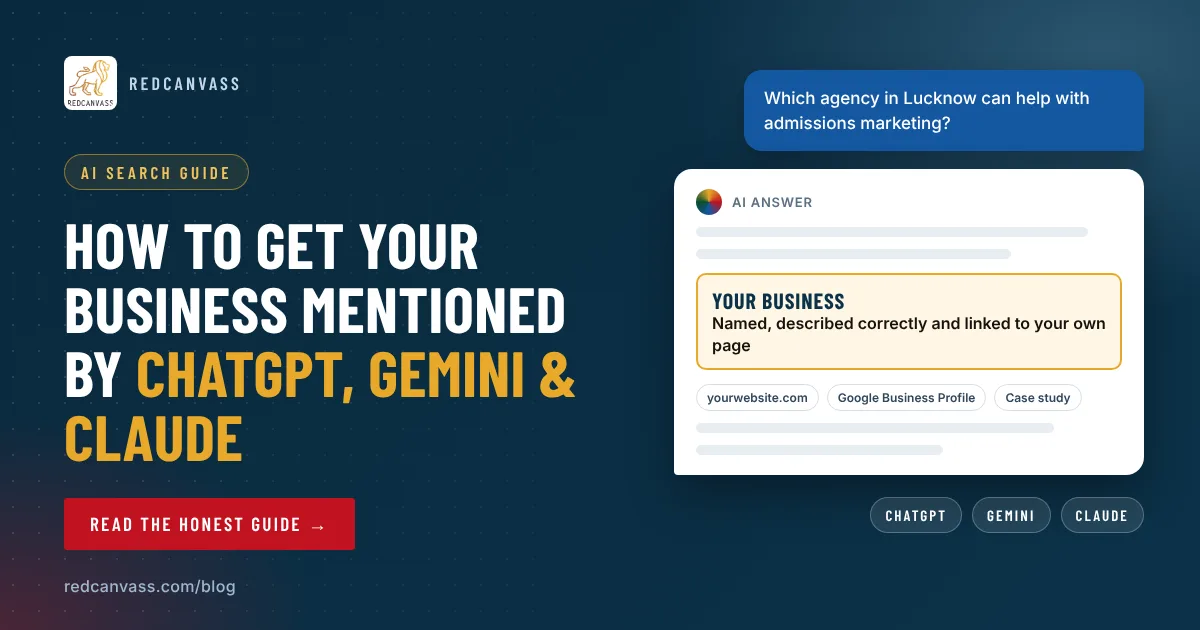
How to Get Your Business Mentioned by ChatGPT, Gemini and Claude (An Honest Guide)
You cannot buy a mention in an AI answer. You can make your business easy for these tools to find, read and trust. Here is the checklist, plus what we found when we ran it on our own website.
Read more →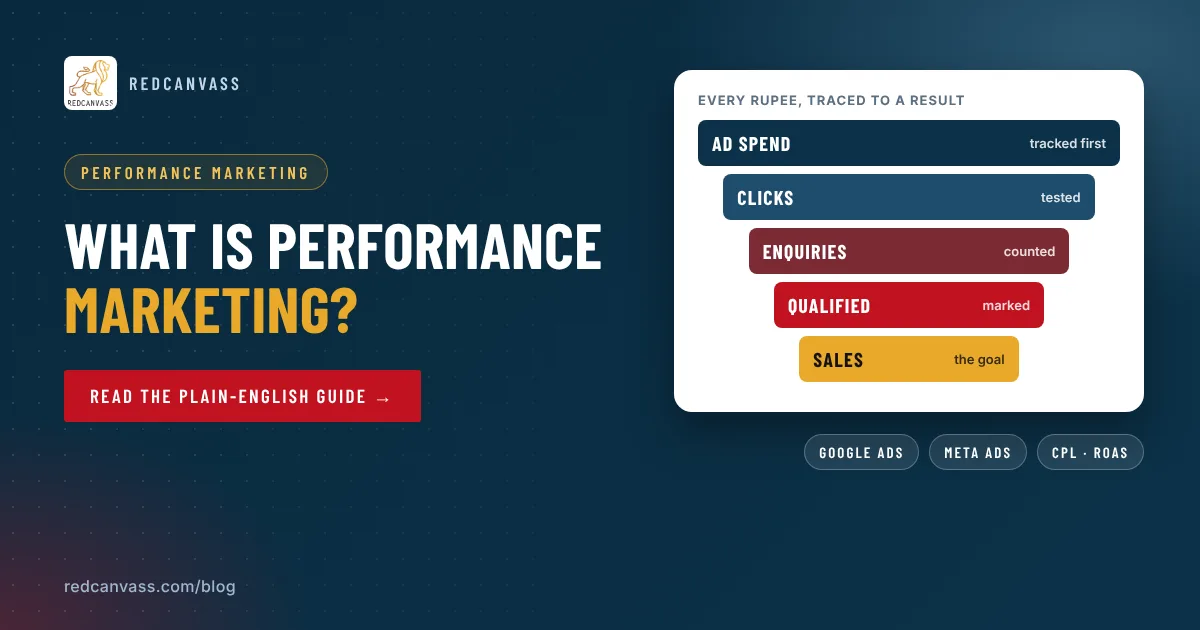
What Is Performance Marketing? A Plain-English Guide for Business Owners
Performance marketing means paying for advertising and judging it by a result you can count, such as an enquiry, an admission or a sale. Here is how it works, the numbers to watch, and real examples from our campaigns.
Read more →