In this article
Quick answer
You cannot buy a mention in ChatGPT, Gemini or Claude, and no agency can promise one. What you can do is make your business easy for these tools to find, read and trust: allow their crawlers, put plain facts on your own pages, keep your details consistent everywhere, answer real customer questions and earn mentions on sites they already cite.
Ask ChatGPT, Gemini or Claude to recommend a business in your city and you will usually get a short list of names. Business owners now ask us the same question every week: how do we get on that list? This guide gives the honest answer, the checks that actually matter, and what we found when we ran those checks on our own website and on a client's.
How AI tools find and choose businesses
An AI assistant can know about your business in two ways. The first is what the model learned during training: a large snapshot of the web taken months before the model was released. You cannot edit that snapshot, and it updates only when a new model comes out.
The second is what the assistant looks up live. For questions such as "best admission consultant in Lucknow" or "Google Ads agency near Gomti Nagar", most assistants now search the web before answering, read a handful of pages and name the sources they used. This is the route you can influence, and it works much like search engine optimisation: the tool has to be allowed to read your pages, understand them and trust them enough to repeat them.
That is why the work below looks familiar. Good SEO is still the foundation. Answer engine optimisation (AEO) and generative engine optimisation (GEO) make the same pages easier to quote.
Which AI crawlers to allow on your website
Each assistant uses named crawlers. If your robots.txt file, firewall or hosting plan blocks the search crawler, that assistant cannot read your pages when it answers live questions. Check with your developer before blocking anything, because some hosting and security tools now offer a one-click "block AI bots" setting.
| Assistant | Reads your site for live answers with | Other crawler names you may see |
|---|---|---|
| ChatGPT | OAI-SearchBot | ChatGPT-User (pages a user asks it to open), GPTBot (model training) |
| Gemini and Google AI Overviews | Googlebot, the same crawler as Google Search | Google-Extended (controls use in Gemini models; does not affect Google Search) |
| Claude | Claude-SearchBot | Claude-User (pages a user asks it to open), ClaudeBot (model training) |
| Perplexity | PerplexityBot | Perplexity-User (pages a user asks it to open) |
Crawler names are those published by each company. Blocking a training crawler while allowing its search crawler is a valid choice; blocking the search crawler usually removes you from that assistant's live answers.
The 8-point checklist
Work through these in order. The first four cost little and fix the most common reasons a business is missing or described wrongly.
- Let the right crawlers inOpen
yourwebsite.com/robots.txtand confirm the search crawlers in the table above are not disallowed. Ask whoever manages your hosting or CDN whether any bot-blocking setting is switched on. - Put key facts on your own pages, in plain textServices, areas served, timings, fees or price ranges, and who you work with. Facts locked inside PDFs, images or Google Drive links are hard for any tool to read and quote.
- Open important pages with a direct answerStart each service page with 40 to 60 words that answer its main question, the way the box at the top of this article does. Assistants lift short, self-contained answers far more easily than long introductions.
- Keep your name, address and phone identical everywhereWebsite, Google Business Profile, Facebook, Instagram, JustDial, IndiaMART and industry directories. Conflicting details make a tool less sure it is describing the right business.
- Strengthen your Google Business Profile and reviewsCorrect categories, service areas, photos, posts and a steady flow of genuine reviews with replies. For local questions, Google's AI answers draw on the same local data as the map results. See our local SEO page for the full list.
- Add structured dataOrganization or LocalBusiness, Service, FAQPage, Article and BreadcrumbList markup tell machines exactly what each page is about. It does not guarantee a mention, but it removes guesswork.
- Publish proof with dates and sourcesCase studies with the client, the period and the numbers are easier to repeat than "we are the best agency". Specific, checkable statements are what AI answers tend to quote.
- Earn mentions on other sitesLocal news, industry associations, partner websites, directories and YouTube. Assistants often build answers from third-party lists and articles, so being named there matters as much as your own site.
What we found when we ran this checklist on our own website
Before publishing this guide we ran the same checks on redcanvass.com on 26 October 2026, when the site had 41 indexable pages. Here is what the review showed.
| Check | What we found | Status |
|---|---|---|
| AI crawler access | robots.txt explicitly allows 16 named crawlers, including OAI-SearchBot, GPTBot, Claude-SearchBot, ClaudeBot, PerplexityBot and Google-Extended | In place |
| Structured data | All 41 pages carry schema markup: Organization, Service, Article, BreadcrumbList and more | In place |
| Image alt text | 282 of 282 images have descriptive alt text | In place |
| Unique page descriptions | 41 of 41 pages have their own meta description and a single H1 | In place |
Source: Redcanvass review of its own published pages, robots.txt and llms.txt, 26 October 2026.
For most businesses the technical side is often fine, or quick to fix. What makes the bigger difference is a clear, quotable answer at the top of each important page, which is why every post on this blog opens with an answer box.
What a client audit showed: DIS School
When we audited the website of Dharwad International School (DIS), a CBSE day and residential school in Karnataka, the school was already being named in Google's AI answers, even though its website had clear gaps.
What was working
- Position 1 for the brand name
- Secure, fast, fully indexable site
- No AI crawlers blocked
- Strong local presence on Google Maps
What was holding it back
- Fees and key facts sat in a Google Drive PDF
- 19 of 25 pages shared one meta description
- Name, address and phone differed across the web
- No FAQs and no structured data detected
Strong local signals were enough to get DIS named. The gaps decide whether that holds as competitors catch up, and whether the AI answer gets the details right, such as fees and boarding options. Fixing them makes the mention more accurate and more likely to repeat.
What does not work
- Buying "guaranteed AI rankings". No agency controls what an assistant says. Treat any guarantee as a warning sign.
- Fake reviews or planted lists. They break platform rules, and assistants increasingly cross-check sources.
- Keyword-stuffed pages written for robots. AI tools quote clear sentences, not repeated phrases.
- Hiding your best information. Prices in images, brochures as PDFs and details only on WhatsApp are invisible to these tools.
- Judging from one chat. Answers change with wording, location, time and the person asking. Look for patterns across many questions.
How to check whether AI tools mention your business
There is no single ranking report for AI answers, so build a simple routine:
- Write 15 to 20 real customer questions, including your city and service, such as "Which school in Dharwad offers boarding for Class 6?"
- Ask them once a month in ChatGPT, Gemini, Claude and Perplexity, in a fresh session, and log whether you are named, whether the details are right, which page is cited and who else appears.
- Watch referral traffic in Google Analytics from chatgpt.com, gemini.google.com, claude.ai and perplexity.ai.
- Ask enquirers. Add "AI assistant (ChatGPT, Gemini etc.)" as an option to the "How did you hear about us?" question on your forms and calls.
Over three to six months this shows whether you are appearing more often and being described correctly, which is the real goal. Our AI search optimisation service runs this tracking for clients alongside the fixes.
Frequently asked questions
Can I pay to be recommended by ChatGPT, Gemini or Claude?
No one can sell you a place in an assistant's normal answers. Those answers are generated from what the tool has learned and what it finds when it searches. Anyone offering guaranteed AI rankings is selling something they do not control.
Is getting mentioned by AI tools different from SEO?
It builds on SEO rather than replacing it. Assistants that search the web still need to crawl, index and understand your pages. The extra work is making facts easy to quote: direct answers, consistent business details, structured data and proof that other sites can confirm.
How long does it take to start appearing in AI answers?
Assistants that search the web live can pick up changes once your pages are crawled again, which can take days to weeks. What a model learned during training changes only when a newer model is released, which can take months. Track trends over a few months rather than judging from one answer.
Do I need an llms.txt file?
It is optional. llms.txt is a proposed plain-text summary of your site for AI tools, not an official standard, and no major assistant has said it depends on it. We publish one because it is cheap to maintain, but crawler access, clear pages and consistent facts matter far more.

Written by Redcanvass TeamThe search, paid media and creative specialists at Redcanvass, a performance marketing company in Gomti Nagar, Lucknow.
Keep reading
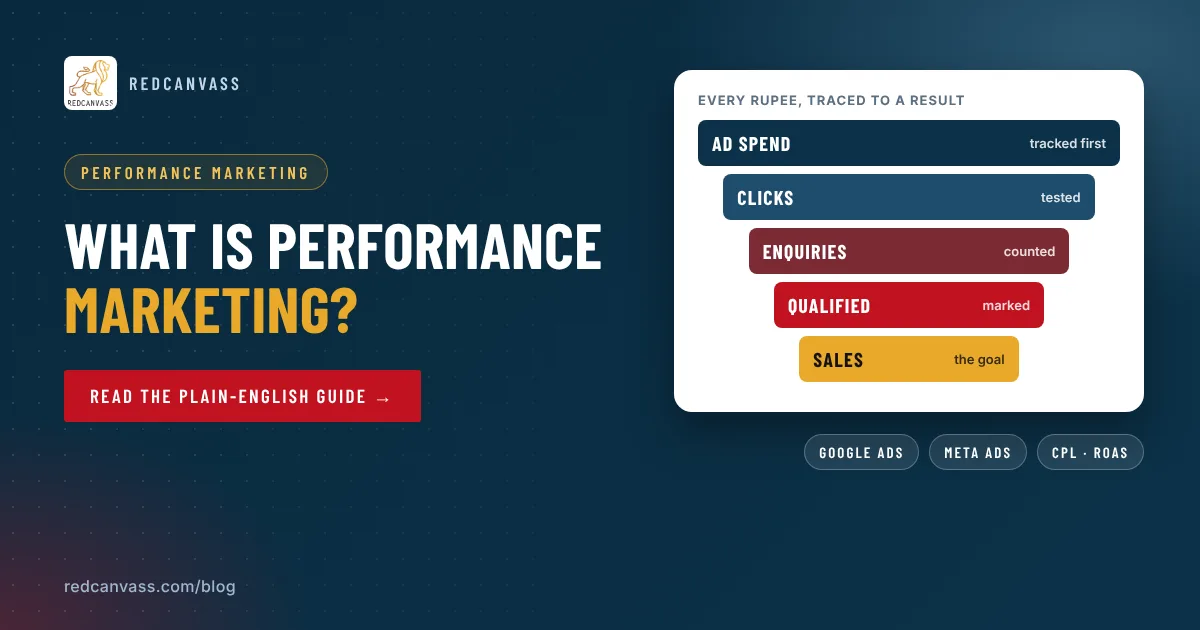
What Is Performance Marketing? A Plain-English Guide for Business Owners
Performance marketing means paying for advertising and judging it by a result you can count, such as an enquiry, an admission or a sale. Here is how it works, the numbers to watch, and real examples from our campaigns.
Read more →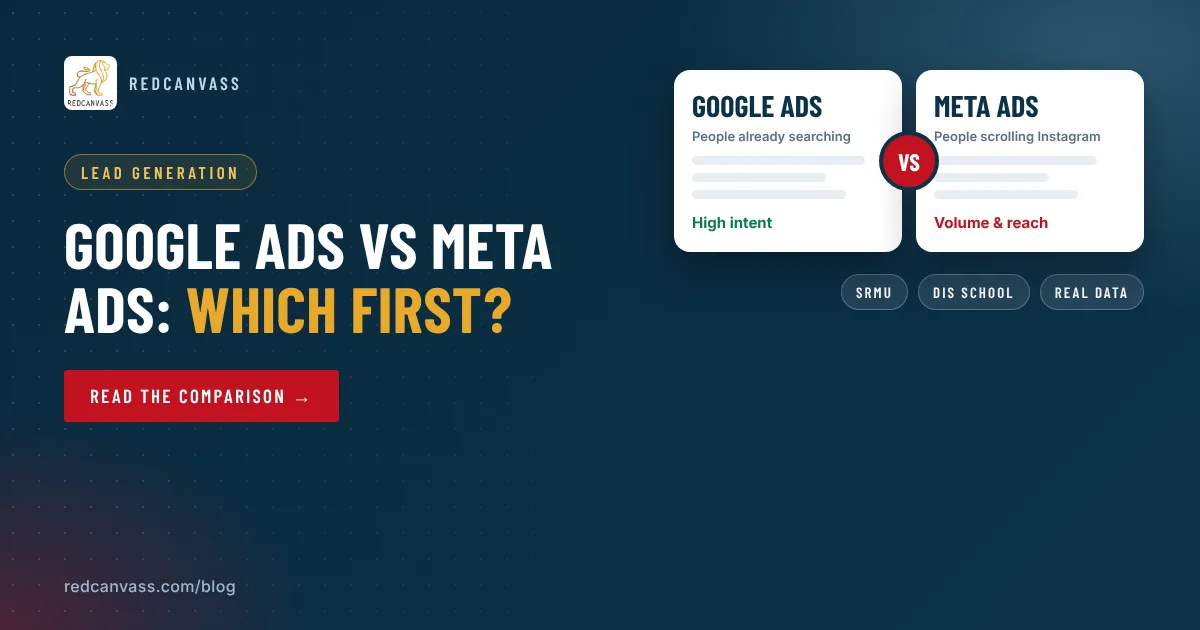
Google Ads vs Meta Ads for Lead Generation: Which Should You Start With?
Google Ads reaches people who are already searching; Meta Ads reaches people before they search. Here is how to choose where to start, how lead quality differs, and what our own campaigns show.
Read more →