In this article
Quick answer
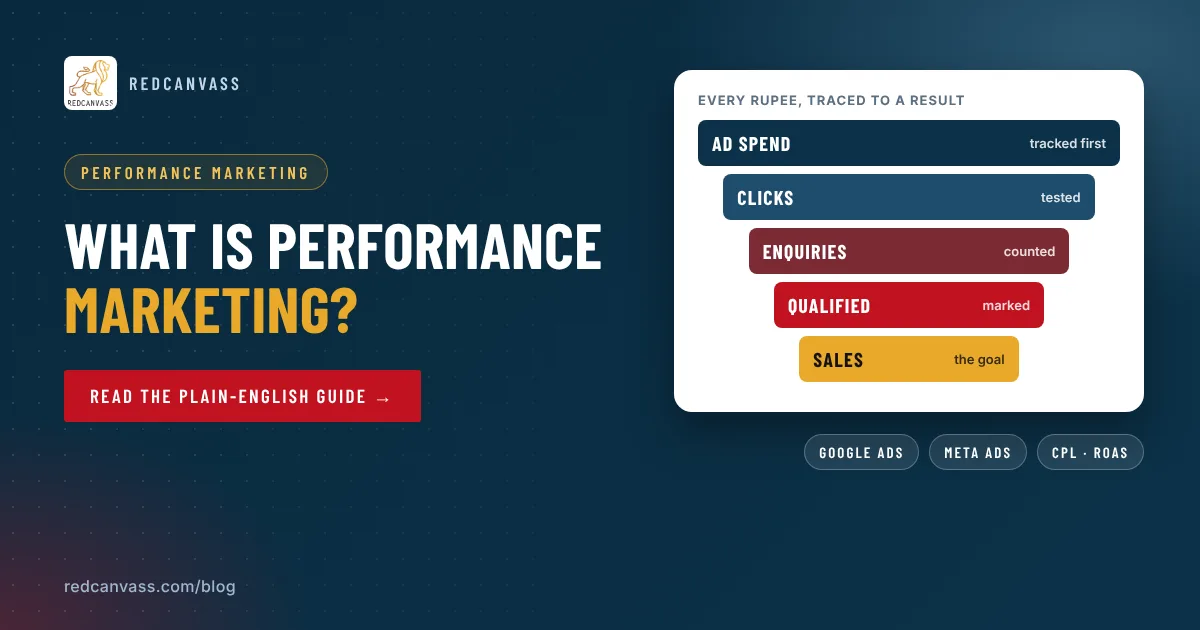
Performance marketing is advertising that is planned, run and judged by a measurable result you agree in advance, such as a qualified enquiry, an admission or a sale, rather than by clicks or reach. Tracking is set up before any money is spent, budget moves to what produces results, and every campaign is reviewed against that result.
Most business owners have been told their ads "got great reach" or "a lot of clicks" and still wondered whether the phone rang more. Performance marketing exists to answer that question. This guide explains how it works, which numbers matter, where it fits and where it does not, using results from our own published campaigns.
How performance marketing works
The idea is simple: connect every rupee of ad spend to a result the business cares about, then keep doing more of what works. In practice it follows five steps.
- Agree the resultDecide what counts: a qualified enquiry, a booked visit, an application form, an admission or a sale. Decide what one is worth to you, so you know what you can afford to pay for it.
- Set up tracking before spendingConversion tracking in Google Ads, the Meta Pixel and Google Analytics, plus a simple way to mark which enquiries were genuine. Without this step, nothing after it can be measured.
- Launch small and testStart with a modest budget across a few audiences, keywords and ad messages. The first weeks are for learning which combinations produce results, not for scaling.
- Improve the whole pathReview the ad, the landing page, the form and the follow-up together. The weak step is often not the ad: it is a slow page, a long form or an unanswered phone.
- Scale with evidenceMove budget towards the campaigns that produce qualified enquiries at a cost you are happy with, and stop the ones that do not.
Performance marketing vs brand advertising
Both have a place. The difference is what each one is built to do and how it is judged.
| Performance marketing | Brand (awareness) advertising | |
|---|---|---|
| Main goal | A countable action: enquiry, application, sale | Being known, remembered and trusted |
| Judged by | Cost per qualified enquiry, cost per sale, return on ad spend | Reach, recall, share of attention |
| When you see results | Within weeks for most lead campaigns, longer for slow decisions such as admissions | Builds over months and years |
| Typical channels | Google Search, Meta lead campaigns, remarketing, landing pages | Video, outdoor, newspaper, broad social reach |
| Risk if used alone | Fights over the same small pool of ready buyers | Hard to prove what the spend produced |
In our experience the two work best together. At SRMU, reach-goal brand campaigns on Meta bought most of the extra impressions, while separate lead campaigns produced the enquiries. Mixing the two goals in one campaign hid what each was doing. Read the full SRMU case study.
Which channels are used
- Google Ads: search, display and YouTube campaigns for people already looking for what you offer.
- Meta Ads: Facebook and Instagram campaigns that reach people before they search, often with instant lead forms.
- YouTube Ads: video that builds awareness and feeds remarketing lists.
- Remarketing: ads for people who visited your site or started an enquiry but did not finish.
- Landing pages and conversion rate optimisation: the page and form where the click becomes an enquiry.
The numbers that matter
You do not need a dashboard full of metrics. These five tell you almost everything.
| Metric | How to calculate it | What to watch out for |
|---|---|---|
| Cost per lead (CPL) | Ad spend ÷ number of leads | Cheap leads are not good leads if nobody qualifies |
| Cost per qualified lead | Ad spend ÷ leads your team marks as genuine | Needs someone to mark lead quality every week |
| Landing page conversion rate | Enquiries ÷ landing page visitors | A low rate usually means the page, not the ad, needs work |
| Cost per sale or admission (CPA) | Ad spend ÷ sales or admissions | Long decisions lag spend by weeks or months |
| Return on ad spend (ROAS) | Revenue from ads ÷ ad spend | Best for e-commerce; harder for services with offline sales |
Timing matters more than most reports admit
At SRMU, leads generated from April to June mostly became admissions in July and August, and nearly three in four Meta-sourced admissions in 2026 arrived in those two months. Judging those campaigns on same-month results would have undervalued them badly.
Results from our own campaigns
These figures come from our published case studies. They show what measured, steadily improved campaigns can do; they are not a promise of what any other business will get.
Each result came from the same habits: tracking first, separating campaigns by goal, testing creative and audiences, and moving budget to what worked. See all case studies for the method behind each number.
Is performance marketing right for your business?
It fits best when most of these are true:
- You can define an enquiry, booking, admission or sale and count it.
- You want to know which spend produces results, not just that ads are running.
- You are willing to test and adjust for a few months rather than judge on week one.
- Your team can respond to enquiries quickly, ideally the same day.
- You want growth you can explain to your partners, board or management.
What it cannot do
Nobody can honestly guarantee a number of leads, a cost per lead or a return on ad spend. Results depend on your offer, prices, market, budget and how enquiries are handled. A good partner promises clear tracking, regular reporting and decisions based on what the data shows.
Frequently asked questions
Is performance marketing the same as digital marketing?
No. Digital marketing covers everything online, including SEO, social media and content. Performance marketing is the part that is paid for and judged by a measurable result such as an enquiry or a sale.
How much budget do I need to start?
There is no fixed amount. The budget needs to be large enough to produce a steady number of leads each month, so you can compare campaigns and learn. Many businesses start with one channel and add more once tracking shows what a qualified lead costs.
How long before performance marketing shows results?
Lead campaigns usually show early signals within the first few weeks, but the first month is mostly testing. For slow decisions, such as university admissions, results can lag the spend by two to three months, so judge them over a full season.
What is a good cost per lead?
It depends on what a customer is worth to you and how many leads turn into customers. A higher cost per lead can be the better deal if those leads convert well. Track cost per qualified lead and cost per sale, not cost per lead alone.

Written by Redcanvass TeamThe search, paid media and creative specialists at Redcanvass, a performance marketing company in Gomti Nagar, Lucknow.
Keep reading

How to Get Your Business Mentioned by ChatGPT, Gemini and Claude (An Honest Guide)
You cannot buy a mention in an AI answer. You can make your business easy for these tools to find, read and trust. Here is the checklist, plus what we found when we ran it on our own website.
Read more →
Google Ads vs Meta Ads for Lead Generation: Which Should You Start With?
Google Ads reaches people who are already searching; Meta Ads reaches people before they search. Here is how to choose where to start, how lead quality differs, and what our own campaigns show.
Read more →